Course Overview
The Bachelor of Engineering in Robotic Systems is a four-year full-time degree programme at the Transport and Telecommunication Institute (TSI) in Riga, Latvia. Designed for students who want to build a serious career in one of the fastest-growing engineering fields on the planet, this programme combines fundamental engineering science with specialist knowledge in robotics, automation, and intelligent systems — preparing you to work with the world's leading manufacturers, aerospace organisations, and technology companies from day one.
Programme Structure The programme runs over four years full-time (or five years part-time), delivering 240 credit points (ECTS), available in both English and Latvian. In your second year, you'll choose one of two specialisation tracks — Industrial Robotics or Autonomous Robots — allowing you to tailor your studies towards your career goals. Throughout the programme, lectures and workshops are delivered by both academic staff and industry professionals with real-world experience from leading engineering and manufacturing organisations.
What You'll Study Your studies cover the full breadth of robotic systems engineering, from programming, mathematics, and electronics, to robot control methods, kinematics and dynamics, sensor systems, microcontroller programming, and intelligent systems. You'll also study business, project management, and engineering graphics, giving you a well-rounded professional toolkit that goes far beyond the lab.
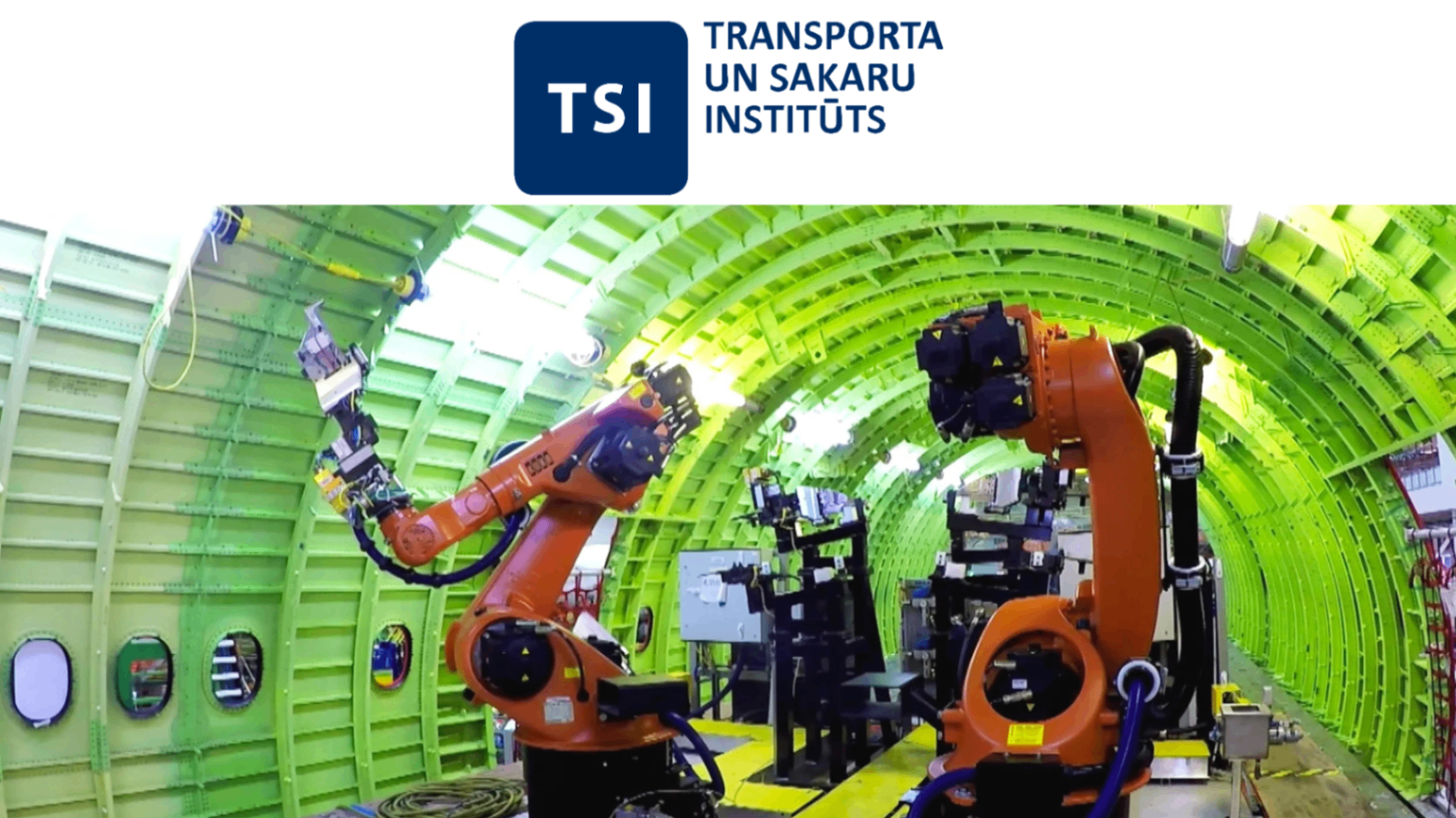
Hands-On From Day One One of the standout advantages of this programme is access to industry-grade robotics labs equipped with robots from world-renowned brands — Kawasaki, KUKA, ABB, Universal Robots, NAO, Khepera IV, and Koala autonomous robots. TSI is also the only university in the Baltics to have a Wire Additive Manufacturing (WAM) lab — AdditiveLab. You will build your first robot during your very first year of study.
Choose Your Specialisation
B1 - Industrial Robotics Focus on the design and programming of industrial robot systems, robotization of manufacturing, programmable logic controllers, and automated systems design — directly applicable to aerospace manufacturing, MRO operations, and aviation ground support.
B2 - Autonomous Robots Focus on embedded systems, autonomous robot planning and movement, intelligent robots, and the design of autonomous systems — directly applicable to drone development, UAM, airport automation, and AI-driven aviation systems.
Pathway to Career and Beyond Graduates are prepared for roles across manufacturing, aerospace, automation, and technology. Career progression can take you from Robot Programmer or Automation Engineer through to Automated Solutions Engineer, Robotic Cells Integrator, Engineering Team Lead, and beyond. Many TSI graduates go on to open their own companies or move into senior management roles. TSI also offers a professional Master's programme in Aviation Management for those looking to advance further.
Alumni of this programme have gone on to work at Mercedes-Benz AG, Porsche, Volkswagen Group, Tesla, Toyota, Škoda Auto, and leading engineering firms across Europe and beyond.
⚠️ IMPORTANT NOTE FOR AVIATION PROFESSIONALS
This is a generalist Robotic Systems Engineering degree. It does not specialise in aviation. However, if you already have a background in aviation engineering or are completing an aviation degree alongside this programme, the combination creates one of the most powerful and rare skill sets in the global aerospace industry , a professional who understands both aircraft systems and the robotics and automation technologies transforming them.
IF YOU HAVE AN AVIATION BACKGROUND — THIS CHANGES EVERYTHING
Aviation is entering an era of unprecedented automation. From robotic MRO systems to autonomous drones and AI-driven airport operations, the industry urgently needs engineers who understand both aviation and robotics. Here is exactly how this degree can position you at the forefront:
Aircraft Maintenance and MRO Robotic systems are increasingly being deployed for aircraft inspection, surface treatment, and component assembly. Engineers who understand both EASA maintenance frameworks and industrial robotics will lead the next generation of MRO operations.
Airport Ground Operations Autonomous robots are being developed for baggage handling, aircraft towing, fuelling, and foreign object debris detection on runways. Your skills in autonomous robot design and programming will directly apply here.
Drone and UAM Manufacturing As air taxis and unmanned aircraft move from concept to production, manufacturing facilities will rely heavily on robotic assembly lines. Industrial robotics specialists with aviation knowledge will be essential to scaling these operations.
Aerospace Manufacturing World-class aerospace manufacturers including Airbus, Boeing, and their Tier 1 suppliers are deploying KUKA and ABB robots extensively on production lines. A degree from the only Baltic university with access to these exact systems gives you a direct pathway in.
Autonomous Aircraft Systems The Autonomous Robots specialisation directly prepares you to work on the embedded systems, movement planning, and intelligent control of unmanned aircraft — one of EASA's identified priority areas for the next decade.
Safety and Quality Assurance Automation Robotic vision systems and automated inspection tools are transforming how aviation safety and airworthiness checks are performed. Engineers who can design and programme these systems will be in extraordinary demand.
ENROLMENT ELIGIBILITY
A document of secondary education (general or special) is required for admission.
Available in: English and Latvian Study mode: Full-time (4 years) or Part-time (5 years)
FEES - 2026/2027 ACADEMIC YEAR
| Full-Time | Part-Time | |
|---|---|---|
| Standard Tuition Fee | €3,900 / year | €3,900 / year |
| EU & EEA Applicants | €3,300 / year | €2,300 / year |
Talk to us
© Aero Launch 2026 | Designed & Developed by TINO DigitalPro